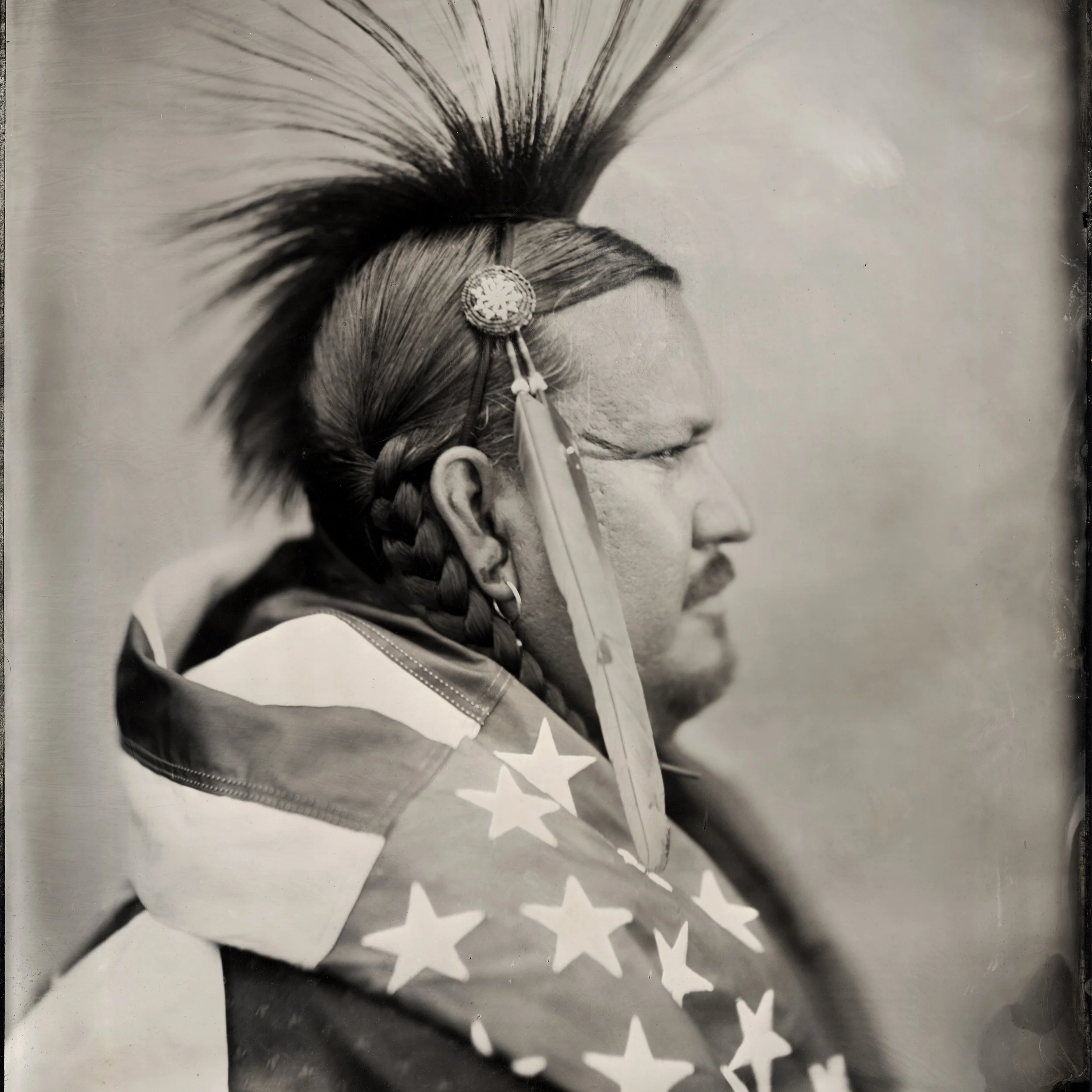
Dante Biss-Grayson, the founder of the International Indigenous Fashion Council. Gathered animal-derived materials gifted and handed down over generations.
The International Indigenous Fashion Council (IIFC) is an Indigenous-led platform to empower Indigenous designers, models and creatives while advocating for fashion sovereignty, cultural integrity, sustainability and fair compensation.
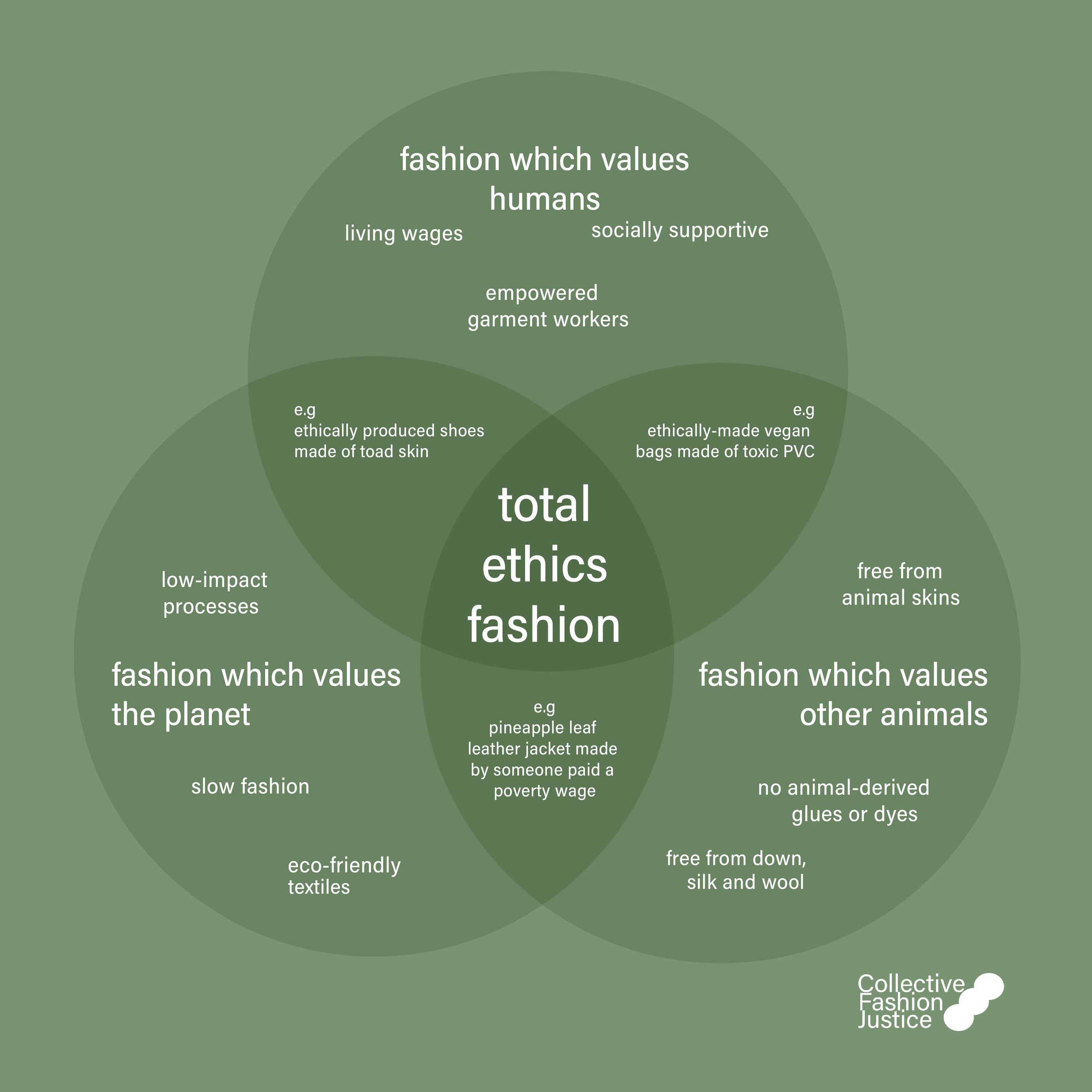
Today, the IIFC and Collective Fashion Justice announce their partnership to advance a complete vision of total ethics fashion: one that respects all life across all species, Indigenous sovereignty, cultural authority, Land, Water, labour, and the living knowledge systems that fashion too often extracts from without consent.
In Total Ethics Fashion (2023), our founder quotes Native American poet, activist and professor Paula Gunn Allen, who said: “It is not a matter of being ‘close to nature’… Earth is, in a very real sense, the same as our self (or selves)”. When we recognise ourselves as one with nature, the ways in which fashion systemically harms individuals becomes more clearly a part of fashion’s sustainability crisis.
For too long, the fashion industry has treated Indigenous Peoples as inspiration but not as authorities. As noted by the IIFC, “our names, stories, designs, symbols, lands, and materials are not just aesthetics. They come from living Nations, families, artists, knowledge holders, and community protocols.”
For total ethics fashion to become a reality, this much change. This is true both because the fashion industry must move beyond its exploitation of Indigenous Peoples themselves, and because when Indigenous Peoples are afforded their rights, we see positive outcomes for the protection of biodiversity, and systems-thinking which aligns with the slower, circular and anti-extractive fashion system we all deserve.
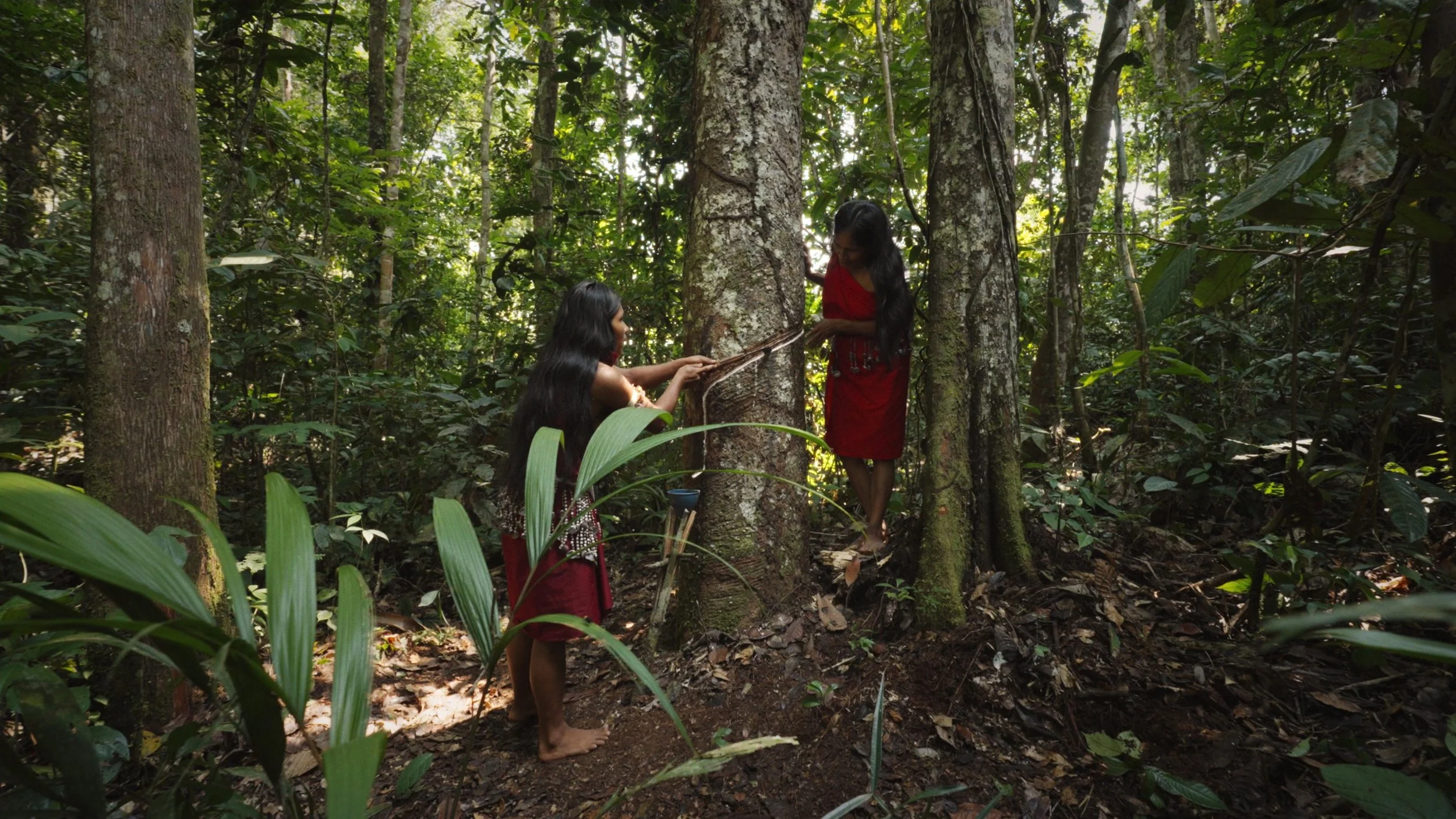
Indigenous Awajún women producing shiringa bio-leather through regenerative tree sap collection.
The fashion industry’s impacts on Indigenous Peoples
Right now, the fashion industry impacts Indigenous communities across the globe in a number of ways. Across the Amazon Rainforest, different Indigenous communities are defending against deforestation for animal-derived leather, for gold and fossil fuels associated with fashion. In Australia, Aboriginal and Torres Strait Islander peoples are advocating for the protection of their totem species, such as dingoes and crocodiles, which are both killed for the fashion industry. In the United States and across Europe, while Indigenous Peoples defend the environment, cultural heritage and crafts associated with fashion, they also have long endured the reduction of culture to trend, styling and marketing. Indigenous Peoples have also been used as scapegoats by industry lobbyists, for example when the fur industry promotes fur made in factory-farms by attempts to associate itself with Indigenous Peoples who use traditional subsistence hunting techniques, when these are not the same.
When Indigenous Peoples are afforded their rights, proper consent is essential to the use of landscapes and designs. This consent protects people, animals and the planet alike. Under the United Nations Declaration on the Rights of Indigenous Peoples, Article 31 affirms the rights of Indigenous Peoples to maintain, control, protect, and develop cultural heritage, traditional knowledge, traditional cultural expressions, designs, visual arts, and intellectual property.
Different laws across the globe have worked to recognise elements of these Rights, such as the U.S.’s Indian Arts and Crafts Act, which prohibits misrepresentation of products being made by Indigenous Peoples if they are not. This is important, as often, products falsely claiming to be Indigenous-made not only steal intellectual property, but do so while creating a product that is often far less ethically and sustainably made.
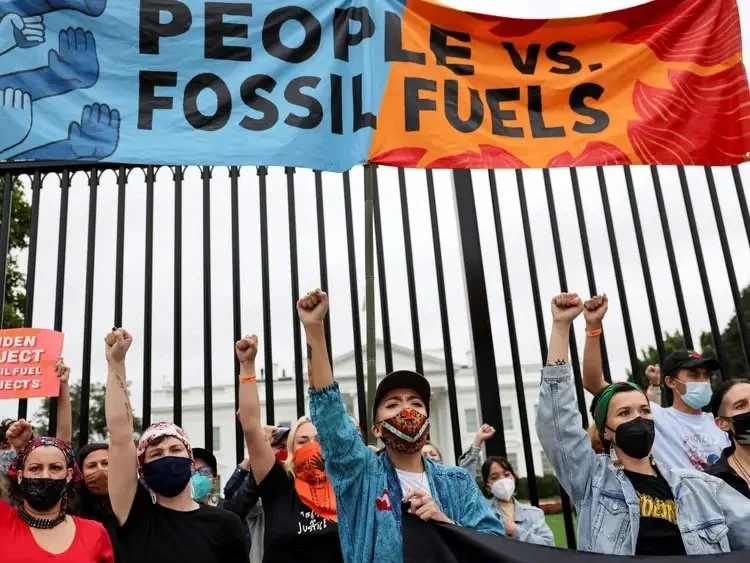
Image: SEED, Australia's first Indigenous youth climate network, demanding climate justice.
Uplifting Indigenous culture and design
Fashion has too often treated Indigenous identity, ceremony, Land, and design as moodboard material rather than as living culture connected to people, place, and responsibility. The IIFC works to change this, and CFJ is a proud collaborator in this work.
Some examples of better practice engagement with Indigenous communities through fashion include Caxacori Studio’s collaboration and conservation agreement with the Awajún people who create shiringa bio-leather from regeneratively collected tree sap, and Ralph Lauren’s Artist in Residence which shifts from Indigenous design inspiration, to the uplifting of Indigenous designers. Australia’s Indigenous Fashion Projects works to empower Aboriginal and Torres Strait Islander designers in the fashion industry, and these kinds of works require industry support.
Real ethical engagement with Indigenous Peoples requires consent, protocol, attribution, fair benefit-sharing, and Indigenous leadership where Indigenous knowledge or cultural expression is involved. Representation alone is not enough. The question is whether Indigenous Peoples have authority, whether communities have consented, whether cultural knowledge is protected, and whether the benefits return to the people and communities connected to that knowledge.
Collective Fashion Justice’s contribution
Our vision of a total ethics fashion future which prioritises the life and wellbeing of people, our fellow animals and the planet is only strengthened by partnership with Indigenous communities, and organisations like the IIFC.
Through our work, we aim to further highlight how the fashion industry impacts Indigenous peoples and land rights, uplift Indigenous-produced and total ethics fashion aligned projects like shiringa bio-leather creation, and ensure that Indigenous communities are not negatively impacted by policies that we develop with the fashion industry.
For example, when we have worked with Australian and Melbourne Fashion Week to ban all wildlife materials (furs, skins, feathers), and with New York Fashion Week to ban fur, we have ensured these policies include an exemption for Indigenous use based on culturally specific subsistence hunting techniques. As a result, the fashion industry at large is shifted beyond animal exploitation while Indigenous communities do not face further cultural erasure.
In Australia, we have found that this exemption usually results in a small amount of these products featuring on runways, but often not sold at scale because of an understanding that the commercial fashion system’s large scale use of wildlife-derived products are incompatible with traditional use that does not aim to commodify animals.
We also plan to engage further on issues associated with water usage in fashion, in acknowledgement of IIFC’s attention to the issue as one critical to “protecting Mother Earth, our creator, and ethics” and how water rights intersect with Indigenous cultures.
Moving forward with the IIFC
We hope this collaboration contributes to broader international conversations related to fashion and Indigenous Peoples rights, as they relate to Earth protection, labour, as well as cultural and intellectual property (a conversation taking place alongside the World Intellectual Property Organization of the United Nations) tied to traditional knowledge and cultural expressions.
“For too long, Indigenous culture has been treated as a mood board for fashion. This collaboration is about changing that standard. Consent, protocol, attribution, and benefit-sharing are not optional gestures; they are the foundation for any ethical engagement with Indigenous knowledge and design.”
- Dante Biss-Grayson, the founder of the International Indigenous Fashion Council