CFJ investigation exposes IUCN conservation status of reptiles likely compromised by fashion industry funding ties
For the past year, Collective Fashion Justice has investigated ties between the fashion industry, those who profit from the trade of wild animal skins, and the International Union for Conservation of Nature. The IUCN has the power to assess and label which species are considered vulnerable, threatened and endangered with extinction. CFJ has uncovered unacceptable biases compromising essential sustainability science to protect wildlife.
This investigation, recently published in part by The Times with an article by science editor, Rhys Blakely, found that the IUCN Specialist Groups for snakes and for crocodiles have significant financial ties to the wildlife skin trade. As a result, scientists attempting to publish research showing this skins trade is unsustainable have reported being removed from Groups, species have had their conservation status changed to permit their exploitation, and a pro-trade position has been maintained, at the detriment of these species.
Please scroll to the end of this page to take action with us and contact the IUCN.
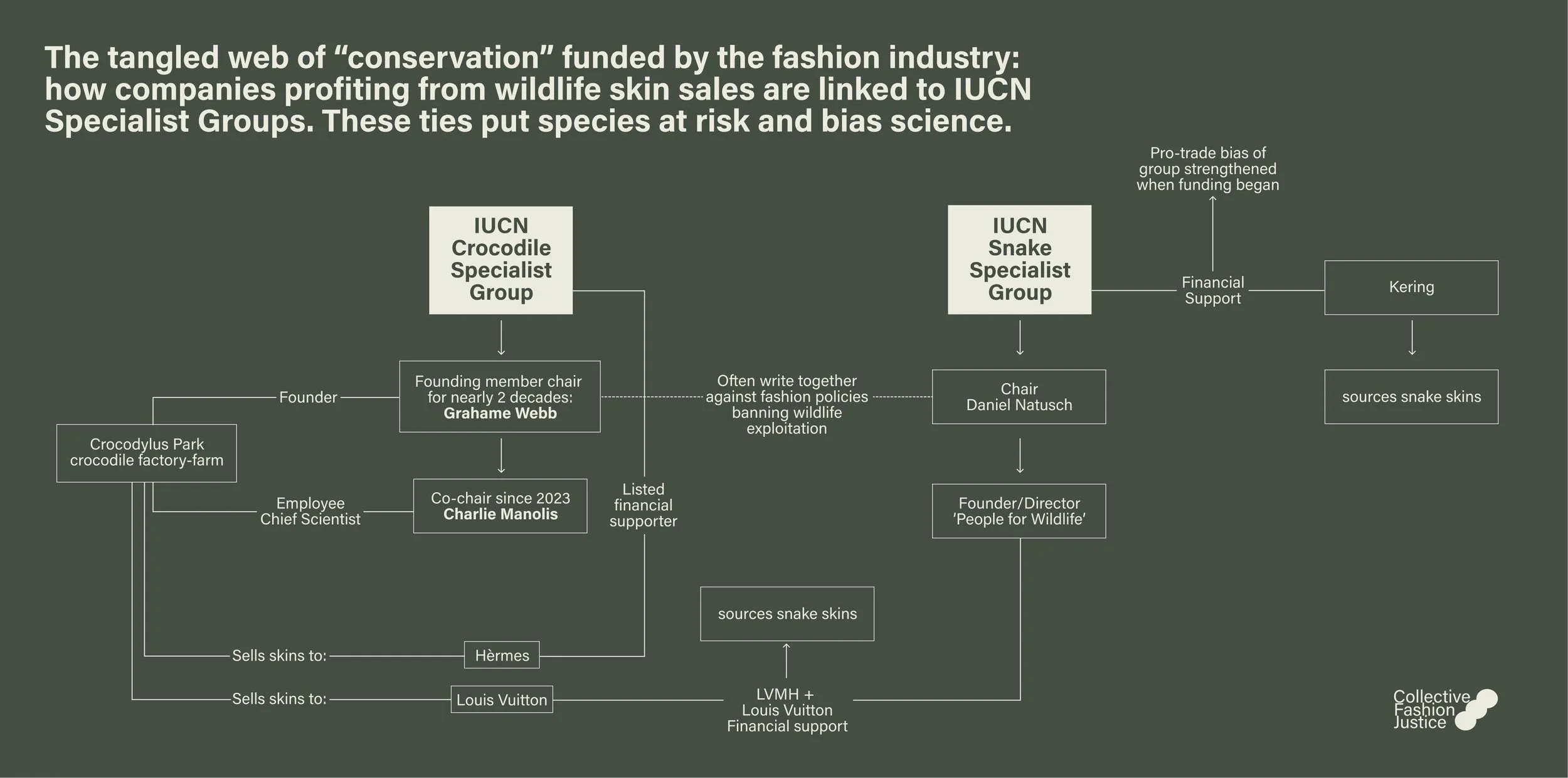
When the founding director of Collective Fashion Justice, Emma Håkansson, discovered that the owner of one of Australia’s largest crocodile factory farms — supplying skins to the likes of Hermès and Louis Vuitton — was also the Chair of the IUCN’s Crocodilian Specialist Group, alarm bells rang.
The discovery led to months of discussions with a range of conservation scientists working within IUCN Specialist Groups, seeking to understand how the fashion industry influences these Groups to promote the exploitation and trade of species the Groups are designed to protect, even when there is a lack of data to support the sustainability of this.
After speaking with a dozen conservationists who have worked within the IUCN for many years, some as long as three decades, a picture of industry bias, corrupted funding sources and squashing of dissent against a pro-trade position became frighteningly clear.
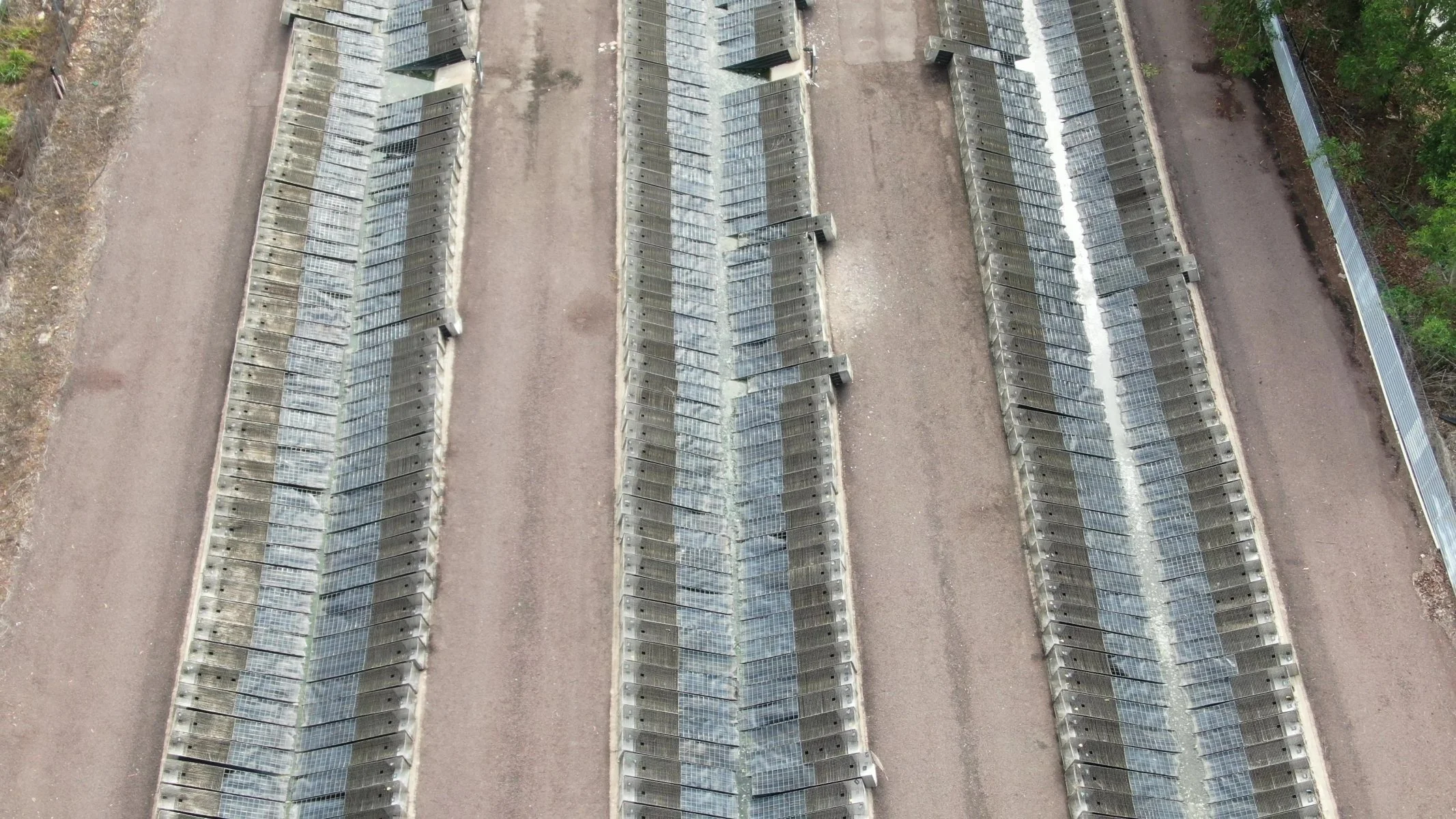
Each of these cages contains a crocodile reared at Crocodylus Park, which also operates a slaughterhouse where crocodiles are skinned for the fashion industry. Image: Farm Transparency Project
Here is what we know about industry bias corrupting the legitimacy of the IUCN’s Crocodile Specialist Group:
The IUCN Crocodile Specialist Group was established in the 1970s, with Dr Grahame Webb as one of the founding members.
At this time, saltwater crocodiles in Australia were listed as endangered. The killing of crocodiles for the skin trade had been made illegal and as a result, crocodile populations were steadily increasing.
As recorded by the UN FAO, Grahame Webb led a submission to reduce these protections for crocodiles, so that they could be factory-farmed for the fashion industry: “In 1985, following extensive research and a published proposal (Webb et al. 1984), Australia’s C. porosus was also placed in Appendix II. Indonesia succeeded in having C. porosus similarly transferred but subject to a set quota..”
By the 90s, Webb had opened Crocodylus Park, a crocodile factory farm. The facility sells crocodile skins to luxury fashion houses including Hermès and Louis Vuitton.
In 2004, Webb became the Chair of the IUCN Crocodile Specialist Group (SG).
Hermès and many other fashion industry and skin trade companies and organisations (Japan Reptile Leather Industries Association, Crocodile Farmers Association of the Northern Territory, United Leather Products Co, etc.) are listed in the Crocodile SGs donor list referenced in their monthly newsletter, though total amounts contributed are not transparent.
The practices and conditions on the crocodile factory farm founded by Webb can be seen in a Farm Transparency Project and Defend the Wild investigation from 2021.
Today, more saltwater crocodiles in Australia are confined to cages and concrete pits like those at Crocodylus Park and other factory-farms, than live in their natural habitat.
The Crocodile SG of the IUCN focuses far more resources on the issues of trade and how to expand the farming and killing of crocodiles for their skins, as compared to other issues such as habitat destruction, as well as other modes of conservation which do not commodify the species in the same way trophy hunting does.
Webb has written countless articles, open letters to industry, and comments to journalists stating that the fashion industry is wrong to ban the sale of wild animal skins, often referring to himself only as the Chair of the IUCN’s Crocodile Specialist Group, not noting his profit-driven motives. Often, these have been co-written with Dr Daniel Natusch, the Chair of the IUCN’s Snake Specialist Group.
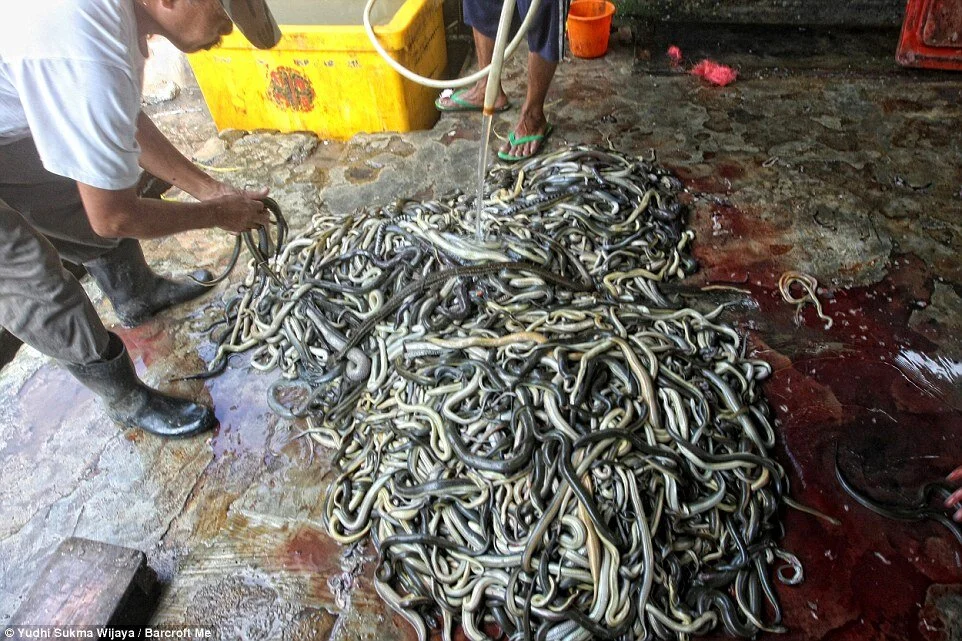
Snakes killed in the fashion industry. Many are very small, suggesting they are juvenile and legally cannot be captured for trade. Image: Yudhi Sukma Wijaya / Barcroft Media
Here is what we know about industry bias corrupting the legitimacy of the IUCN’s Snake Specialist Group:
Dr Daniel Natusch is the Chair of the Group. Natusch is the director of a charity called People For Wildlife, which has a stated mission to create economic value from nature. The organisation has an ongoing paid partnership with LVMH and Louis Vuitton, which uses a large amount of snake skin. The partnership is listed as part of LVMH’s Life 360 initiative, which refers to the sourcing of “responsible” exotic skins.
Funding of the Snake Specialist Group is opaque, however in 2013 Kering began its paid partnership with the Group. Kering also sources a large amount of snake skins.
Perhaps most concerningly, we were told by numerous IUCN scientists that a colleague of theirs in the Snake Specialist Group was allegedly kicked out of the Group by Natusch, after he attempted to publish data that showed a lack of legitimate data to support the claim that the snake skin trade was sustainable.
This is not the first time scientists have been blocked from publishing data which shows the wildlife skin trade is unsustainable. Dr Sabine and Dr Thomas Vinke attempted to co-publish research about the red tengu, a lizard frequently exploited for fashion (including by large brands mentioned in this article), but were removed from their IUCN Specialist Group for attempting to have the tegu re-listed as endangered, after being told to leave the issue of leather alone. More can be seen in this Oxpeckers article, and CFJ has confirmed this information with interviews and documentation provided by the Vinkes.
Perhaps unsurprisingly then, Natusch regularly critiques the fashion industry when it bans wild animal skins. He often does so as though he represents the IUCN’s Snake Specialist Group, though other IUCN members note this is not acceptable protocol as Groups have opposing views within them. When London Fashion Week banned wild animal skins following CFJ’s engagement with them, he heavily criticised the organisation, stating that “if designers were serious and informed themselves, we’d all be wearing snakeskin underpants”.

What does this mean for the IUCN and for the fashion industry?
This level of fashion industry funding, control and bias over the IUCN Specialist Groups for crocodiles and for snakes means the fashion industry should not trust the wildlife trade-related work and recommendations coming from these Groups as independent and legitimate.
Numerous IUCN scientists within these Groups, which are made up of a large number of scientists — many of whom fight against this industry bias from a position of lesser power than their Chairs and other peers — reiterated to Collective Fashion Justice the total lack of data to support claims that reptile skin trades are sustainable long term. Others pointed out that just as with trophy hunting, commodifying wildlife through the fashion industry reduces the perceived value of these species as contributors to their ecosystems, as compared to valuable financially if killed, whether legally or illegally.
Just as Chanel, Victoria Beckham, London Fashion Week, Copenhagen Fashion Week, Burberry and other major fashion industry players have banned the use of skins from wild animals, the wider fashion industry must commit to ending this trade, as well as ending its reliance on the IUCN’s endorsement of this trade to justify not doing so yet.

What is Collective Fashion Justice calling for?
Collective Fashion Justice is calling for the fashion industry to end its wildlife trade, continuing to engage directly with brands and organisations (including fashion week organisers) towards this essential goal.
We are also calling for changes within the IUCN Specialist Groups, to return their work to the independence it deserves:
The IUCN should initiate a process of institutional self-examination to review current codes of conduct, and to introduce and implement more rigorous and transparent governance procedures in relation to SSC specialist groups. The findings of this should be public.
A public register of conflicts of interest should be established for all Specialist Groups. The current IUCN conflicts of interest policy pays lip-service to potential and actual conflicts of interest, yet no conflicts of interest are publicly disclosed. There are countless examples of ‘potential conflicts of interest’ that warrant public disclosure and justification listed above.
Public disclosure of all funding for all IUCN Specialist Groups should be listed, including specific amounts and sources. Currently, each group is required to publish an annual report documenting progress in the implementation of the 2021-2025 Species Strategic Plan, which provides a comprehensive description and analysis of the groups activities and results achieved. However, there are no requirements to disclose what funding has been received in order to conduct these activities, where these funds came from, and under what conditions these funds were provided. This transparency is imperative to preserve the integrity of the IUCN, and the findings and determinations of the Red List.
A policy preventing IUCN Specialist Groups from being chaired by personnel with clear links and conflicts of interest due to involvement with the species’ trade must be established. Specialist Group Chairs have final say on a number of important issues, including which experts are invited to be in a Group, which has a significant impact on the ultimate recommendations and outcome of assessments conducted by the group. It is vital that the Chairperson for each Specialist Group is independent, with no direct commercial interests related to the Group’s activities.
These calls should be supported by anyone who respects scientific independence, regardless of their position on the trade of wildlife.
Collective Fashion Justice has also launched its International Declaration for the Effective and Compassionate Conservation of Wildlife, with over 20 founding signatory conservationists endorsing it and its calls to end fashion’s wildlife trade.