
Peer-reviewed research shows lack of data to back claims fashion’s wildlife exploitation supports “conservation”
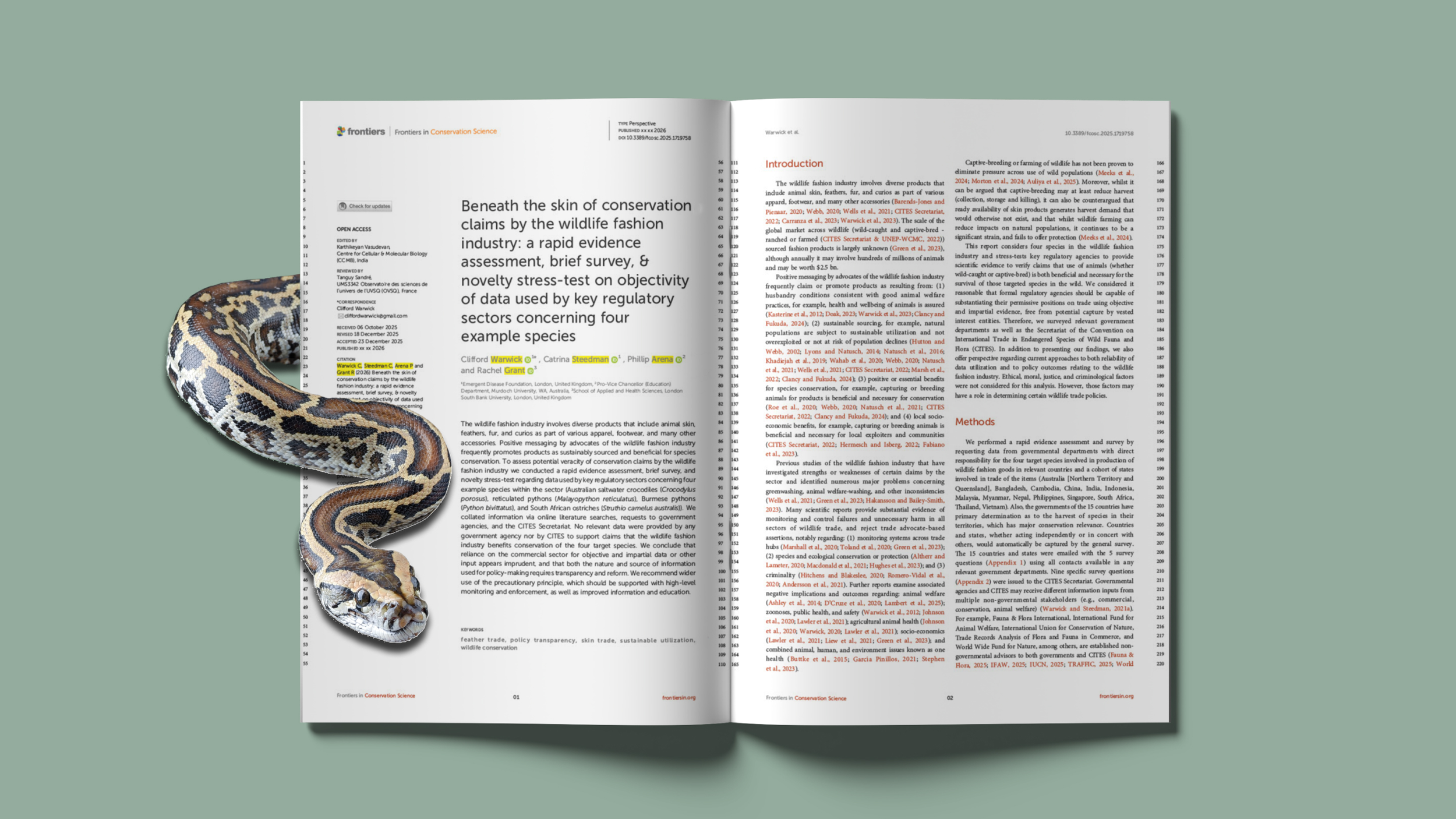
A new article published in the Journal Frontiers of Conservation Science finds that there is no relevant government agency nor CITES data provided to support claims that some of the most commonly exploited wildlife species are conserved by fashion’s use of their skins and feathers.
These species include saltwater crocodiles, reticulated and Burmese pythons, and South African ostriches.
The research, produced by four leading conservation scientists, found that despite claims that the fashion industry protects and “conserves” wildlife species by “sustainably” killing them for their skins and feathers, there is a serious lack of impartial data to support such claims.
To assess potential veracity of conservation claims by proponents of wildlife exploitation of fashion, the scientists conducted a rapid evidence assessment, brief survey, and novelty stress-test regarding data used by key regulatory sectors concerning four commonly exploited example species within the sector (Australian saltwater crocodiles (Crocodylusporosus), reticulated pythons (Malayopython reticulatus), Burmese pythons (Python bivittatus), and South African ostriches (Struthio camelus australis).
After collating data via online literature searches, requests to government agencies, and the CITES Secretariat, no relevant data was provided by any government agency nor by CITES to support claims that the wildlife fashion industry benefits conservation of the four target species.
The researchers concluded that reliance on the commercial sector for objective and impartial data or other input appears imprudent, and that both the nature and source of information used for policy-making requires transparency and reform.
The following recommendations were made:
1. Information (and sharing thereof) by governments and policy-makers should be improved and developed and rely primarily on independent, objective, impartial, scientific data and opinion, and not based on or prioritise trade/trade-advocate-related information.
2. Precautionary principles and positive lists should be applied so that no commerce is permitted unless safety for animal welfare, species conservation, ecological protection, public health and safety, and socio-economics is advance proven; further, that wherever objective data are lacking or unclear, or where objective evidence of unnecessary harm exists, including with regards to implications of the one-health paradigm, then assumptions should disfavour commodification or its promotion. Thus, positive lists plus high-level monitoring and enforcement should become the default regulatory framework.
3. Rapid bans on trade plus high-level monitoring and enforcement should remain the gold-standard method for
control on identification of manifest threats.
4. Investigative criteria such as provided in Appendix 1 of the research should be comprehensively established to stress-test any claims or protocols advocating prospective or existing utilisation of any species. Essentially, claims advocating safe commerce & benefits of wildlife trade should be accountable to the principle of “Prove it or lose it”.
5. Improved education should be developed, for example via mandatory product labelling, with obligations placed on
governments and other agencies and policy-makers to inform potential consumers that the terms ‘sustainable’
and ‘farmed’ also imply wildlife fashion products includes wild-caught animals.
6. Further independently managed research, e.g., via collaborations with universities and other scientific institutions worldwide, should be conducted regarding exploitative claims and suggested benefits. Such studies should be funded by interested parties, including governments, CITES, other scientific entities, and the trade network, whilst having no input regarding design, analysis, conclusions, recommendations, or other directional roles.
In summary, this peer-reviewed research showed that the fashion industry’s reliance on commercial industry for data is dangerous to wildlife, with serious reform needed, and bans on the use of these animals recommended.
The fashion industry should end its use of these wild animal skins and feathers, as their claims that the use of these conserves species is not supported by data, and we know that there is no ethical way to source these.
Collective Fashion Justice funded this research requesting analysis of the four target species, but had no input regarding design, analysis, conclusions, recommendations, or other directional role in the report.
Download a pdf version of the paper here.